
Best BBA College in Bangalore After 12th: General Management vs Aviation
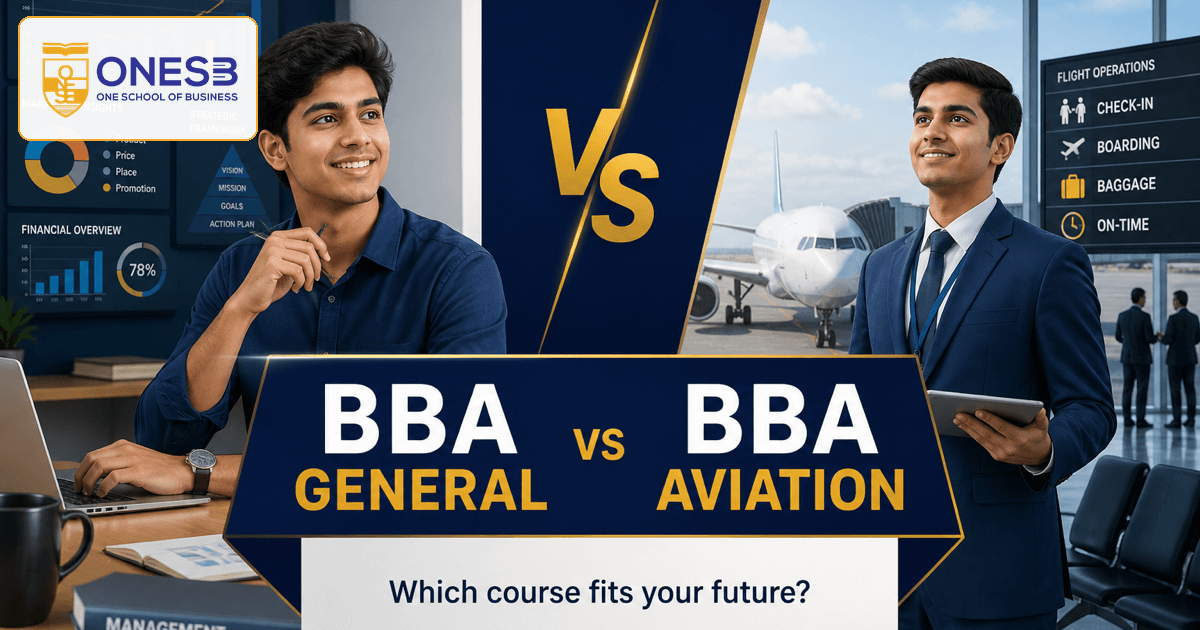
Neither is universally better. They answer two different questions. BBA General Management is the right pick if you want maximum career flexibility — it keeps marketing, finance, analytics, supply chain and e-commerce all open, and it is the safer choice if you are still deciding what you enjoy. BBA Aviation Management is the right pick if you already know you want airports, airlines, cargo or travel, because it gives you industry-specific vocabulary and internships that a general graduate simply does not have.
The practical test: if you can name the industry you want to work in, specialise. If you cannot yet, stay general and specialise later through electives or an MBA.
What this guide covers
- What "best BBA college" really means
- The 60-second decision table
- BBA General Management, explained
- BBA Aviation Management, explained
- Side-by-side course comparison
- Career outcomes for both routes
- Fees in Bangalore and what they buy
- Eligibility and the 2026 timeline
- Five questions to ask before you pay
- Where OneSB fits
- Frequently asked questions
Search "best BBA college in Bangalore after 12th" and you will get roughly the same page fifteen times over. A numbered list of colleges. A fee column. A salary column. Usually the college that published the list quietly sitting at number one. What almost none of these guides do is answer the question a Class 12 student is actually stuck on, which is not which college but which BBA.
That matters because the choice you make in the application form shapes the next three years far more than the campus you pick. A student who chooses BBA General Management and a student who chooses BBA Aviation Management at the very same college will study different subjects from the second year, do different internships, and walk into different interview rooms. Getting that decision right is worth more than moving one place up a ranking table.
This guide compares the two routes honestly, using a decision table, a subject-level comparison, and realistic career outcomes. One School of Business (OneSB) runs both programmes — a BBA in General Management and a BBA in Aviation Management — so we have a clear interest here. We have tried to write it so that it is still useful if you never apply to us.
What "best BBA college in Bangalore" actually means after 12th
Bangalore has well over 150 colleges offering a BBA or its close cousins, BBM and BMS. At that volume, "best" stops being a single ranking and becomes a filter you apply to your own situation. Five filters do most of the work.
Recognition and affiliation. Check that the college is affiliated to a recognised university and that the programme carries the approvals it claims. This is what makes your degree usable later for an MBA admission, a government exam, or a study-abroad application. It is a five-minute check and it eliminates a surprising number of options.
Specialisation depth, not specialisation count. Many colleges advertise six or seven specialisations. Ask how many semesters are actually devoted to each one, and which tools are taught. A specialisation that exists as two elective papers in the final year is a label. One that runs from the second year with lab work behind it is a skill.
Internship reality. Ask for the names of the companies that took interns from your specific programme in the last two years. Not the university-wide list. Not the MBA list. Colleges that have genuine placement relationships answer this immediately; the ones that hesitate are telling you something.
Total cost against realistic outcome. Annual BBA fees in Bangalore run from well under ₹1 lakh at aided and government-affiliated colleges to around ₹3 lakh a year at the best-known private universities. Published average packages for BBA graduates across the city sit in a fairly narrow band of roughly ₹3–8 LPA. A three-year programme costing ₹9 lakh and one costing ₹4 lakh often feed into the same salary range, which makes cost a genuine decision factor rather than a footnote.
Batch size and attention. Undergraduate management education is a skills business. In a batch of 300, your presentation gets four minutes of feedback a semester. In a batch of 60, it gets four minutes a week. For a 17-year-old learning to speak in a boardroom, that difference compounds.
The 60-second decision table
Before the detail, here is the fastest honest way to sort yourself into one of the two routes. Read the left column, and see which side you keep landing on. If most of your answers fall in one column, that is your programme.
| If this sounds like you… | Choose BBA General Management | Choose BBA Aviation Management |
|---|---|---|
| Clarity about your industry | You cannot yet name one industry you want to work in, and you would rather keep options open | You can already say "airports" or "airlines" without hesitating |
| What excites you at work | Campaigns, numbers, dashboards, brands, building something of your own | Live operations, shift work, solving problems in real time with real people in front of you |
| Comfort with uncertainty | You want a degree that reads well across every sector, including sectors that do not exist yet | You are comfortable betting on one large, regulated, fast-growing sector |
| Skill you most want to leave with | Analytics, digital marketing, finance and supply chain literacy that transfers anywhere | Airport and airline operations knowledge that most graduates simply do not have |
| Where you see yourself at 25 | Analyst, marketer, or manager in a company you may not have heard of yet | Duty manager, station executive or cargo lead at an airport, airline or ground handler |
| Postgraduate plan | Likely an MBA in two to four years, possibly in analytics or finance | Either straight into industry, or a specialised MBA in aviation or logistics later |
| Parental concern to address | "Will this degree be too broad to stand out?" — answer with specialisation depth and internships | "Is he limiting himself to one industry?" — answer with the business core inside the degree |
Most students find they lean clearly one way after that table. If you are genuinely split down the middle, read the next two sections carefully, then talk to someone who teaches both. A twenty-minute conversation with an admissions mentor who knows the two syllabi will resolve more than another week of scrolling.
BBA General Management, explained properly
A general BBA is not a vague BBA — or at least it should not be. The good ones are built as a broad business core plus real specialisation tracks that start early enough to matter. Over six semesters you get the foundations every manager needs, then depth in the areas that are hiring.
The business core
- Principles of management and organisational behaviour
- Financial and cost accounting
- Business communication and business law
- Economics, business mathematics and statistics
- Marketing fundamentals and consumer behaviour
- Human resource management and operations
The specialisation tracks
- Digital marketing — SEO, SEM, social, content, performance analytics
- Business analytics — Excel, Power BI dashboards, statistical modelling, AI-assisted insight
- Logistics and supply chain — procurement, inventory, warehousing, global trade compliance
- Financial management — corporate finance, valuation, budgeting
- Entrepreneurship — business model design, pitching, new venture management
The reason this route remains the default recommendation for most Class 12 students is simple: at seventeen, very few people know what they want to do, and a general BBA is the cheapest way to find out without losing time. You will spend the first year discovering whether you are a numbers person or a people person, and the second and third years building on whichever answer you get.
The failure mode to watch for is a general BBA taught entirely as theory. If nobody in the programme has opened Power BI, run a live campaign, or read an actual profit and loss statement by the end of the second year, the breadth becomes a liability rather than an asset. Ask to see the lab, not the brochure.
BBA Aviation Management, explained properly
The most common misunderstanding about this degree, and the one parents raise within the first two minutes of every conversation, is that it trains pilots. It does not. Pilot licensing and aircraft maintenance engineering are seperate technical pathways with their own regulators and their own entry tests. BBA Aviation Management is a business degree pointed at one industry: it trains the people who run airports, airlines, cargo terminals and travel operations.
Structurally it works like a general BBA with the second year swapped out. The first year builds the same business foundations. The second year goes deep into how the industry actually operates. The third year adds strategy plus an internship where the industry knowledge starts paying off.
Operations you will study
- Airport operations and terminal management
- Airline management, scheduling and revenue basics
- Aviation safety, security and regulatory frameworks
- Cargo and freight operations
- Passenger services and customer experience
- Ground handling and turnaround coordination
What ties it together
- Airport retail and commercial revenue management
- Crisis and emergency management in aviation
- Global aviation policy and trends
- Airport-operations simulation and aviation management software
- Industry visits within Bengaluru's aviation cluster
- Sector internship in the fifth or sixth semester
Why this route is worth considering seriously from Bangalore in particular: the industry is next door. Kempegowda International Airport is one of India's busiest and its expanded Terminal 2 has pushed capacity and hiring upward. Around it sits a full aviation economy of airline offices, ground-handling firms, cargo and freight operators, travel companies and the aerospace cluster anchored by HAL. India is now the world's third-largest domestic aviation market, and the aircraft orders placed by Indian carriers will need trained ground and management staff for a decade and more. Studying the sector in the city that hosts it means your industry visits, internships and first interviews all happen where you already live.
The honest counterweight is concentration risk. Aviation is cyclical, and it is the first industry to freeze hiring when travel demand drops — anyone who watched 2020 knows this. A specialised degree is a bet on a sector. Because the business core sits inside the degree, an aviation graduate can and does move into logistics, hospitality, retail operations or general management, but you should make that bet knowingly rather than discover it later.
Side-by-side course comparison
Same college, same three years, same class 12 marksheet — two quite different degrees. This table sets them against each other on the dimensions that change your outcome.
| Dimension | BBA General Management | BBA Aviation Management |
|---|---|---|
| Duration | 3 years, 6 semesters | 3 years, 6 semesters |
| Eligibility | 10+2 in any stream — Science, Commerce or Arts | 10+2 in any stream — Science, Commerce or Arts |
| Where it specialises | By business function — marketing, analytics, finance, supply chain | By industry — airlines, airports, cargo, travel |
| Signature skills on your CV | Power BI and dashboarding, digital campaign management, financial analysis, supply chain planning | Terminal and airside operations, revenue management basics, safety and compliance literacy, GDS familiarity |
| Practical component | Live client briefs, digital and analytics labs, semester projects, industry internship | Airport-operations simulation, aviation software, industry visits, sector internship |
| Typical first roles | Digital marketing executive, business or data analyst, management trainee, e-commerce or operations executive | Airport operations executive, airline customer experience associate, cargo and logistics executive, ground handling supervisor |
| Sector spread of employers | Very wide — IT services, BFSI, FMCG, e-commerce, consulting, startups | Focused — carriers, airport operators, ground handlers, freight forwarders, travel platforms, plus adjacent logistics |
| Realistic entry salary band | Roughly ₹3–6 LPA in Bangalore, higher with a strong analytics or digital portfolio | Roughly ₹2.5–5 LPA at entry, with structured growth into supervisory and managerial scales |
| Main risk | Breadth without depth if the programme is taught only as theory | Sector concentration — aviation hiring is cyclical |
| Natural next step | MBA in analytics, marketing or finance; or straight into a corporate role | Industry role first; later an MBA in aviation, logistics or air transport management |
Career outcomes: where each route actually lands you
This is the section parents read twice, so let us be specific rather than aspirational. These are the roles graduates of each programme realistically enter in their first two years, not the designations they might reach at 35.
After BBA General Management
Digital Marketing Executive
Run search, social and content campaigns for brands or agencies. Bangalore's density of startups and D2C brands makes this the highest-volume entry role for general BBA graduates.
Business / Data Analyst
Build dashboards, clean data and turn it into decisions. The role that rewards analytics coursework most directly, and the one with the steepest salary curve.
E-Commerce & Category Executive
Manage listings, pricing, inventory and marketplace performance for online retail and quick-commerce businesses.
Supply Chain / Operations Executive
Coordinate procurement, warehousing and dispatch. Steady demand across manufacturing, retail and logistics companies.
Junior Financial Analyst
Support budgeting, reporting and financial analysis in corporate finance teams and shared-services centres.
Management Trainee
Structured rotational programmes at larger companies — the classic route into general management for graduates with strong communication.
After BBA Aviation Management
Airport Operations Executive
Coordinate terminal operations, gate allocation and passenger flow for airport operators and their service partners.
Airline Customer Experience Associate
Front-line passenger handling at check-in, boarding and arrivals, including service recovery. Builds quickly into supervisory roles.
Cargo & Freight Executive
Handle freight documentation, coordination and compliance for cargo carriers, freight forwarders and express logistics firms.
Ground Handling Supervisor
Oversee baggage, ramp and turnaround operations with the agencies that service multiple airlines at a single station.
Revenue Management Analyst
Work on seat inventory, pricing and demand forecasting. Analytically demanding and the best-paid early aviation track.
Travel & Tourism Management
Roles with travel companies, online travel platforms and tour operators, where aviation knowledge is a direct hiring advantage.
BBA fees in Bangalore and what they actually buy
Fees for a BBA in Bangalore span an unusually wide range, and the range does not map neatly onto outcomes. Government-aided and older aided colleges can sit well below ₹1 lakh a year. Established private universities and autonomous colleges commonly run between ₹1.25 lakh and ₹3 lakh a year, which works out to roughly ₹4 lakh to ₹9 lakh across the three years. Programmes with international or professional integrations go higher still.
Here is the part that matters for a decision. Published BBA placement averages across the city's better-known colleges cluster in a fairly tight ₹4–8 LPA band regardless of whether the fee was ₹1 lakh a year or ₹3 lakh. The extra fee is often buying campus scale, brand recognition and facilities — all real things, but not linearly connected to your first salary. So the useful question is not "which is the most expensive college I can afford" but "what does this specific fee buy me that a cheaper one does not, and will a recruiter notice it?"
Three cost items students forget to add up: the mandatory certification or training fees some programmes charge on top of tuition, hostel and transport if you are relocating within or into the city, and the exam and university fees billed each semester. Ask for the full three-year cost in writing, not the first-year figure. Colleges that will not put it in writing are answering a different question than the one you asked.
Compare the two OneSB BBA programmes directly
Rather than choose from a brochure, get the semester-wise syllabus for both routes side by side, along with this year's eligibility, the full three-year fee and the internship record for each programme.
Eligibility and the 2026 admission timeline
The good news for most Class 12 students is that BBA entry is far more accessible than MBA entry. There is no single national exam you must clear, and stream restrictions are rare.
| Criterion | What to expect |
|---|---|
| Qualification | Class 12 / 10+2 / PUC pass from a recognised board — CBSE, ICSE, state boards or equivalent |
| Stream | Any stream for both programmes at OneSB. A few colleges elsewhere prefer Commerce or require Maths, so check individually |
| Minimum marks | Commonly 45%–60% aggregate depending on the institution; premium colleges set higher cut-offs |
| Entrance route | Merit on Class 12 marks, institution-specific tests, or national UG aptitude tests. At OneSB, admission runs through application, aptitude test or group discussion, and a personal interview |
| Applications open | Typically December to January for the following academic year, with rolling intake at many private colleges until seats fill |
| Tests and interviews | March to May in most cycles |
| Results, counselling and classes | Offers and counselling through June and July; classes generally begin in August |
| Documents to keep ready | Class 10 and 12 marksheets, transfer certificate, migration certificate where applicable, ID proof, passport photographs, category certificate if relevant |
One practical point on timing. Because good private colleges cap batch sizes, popular programmes fill before the official deadline in most years. If you have a clear first preference, apply in the first window rather than the last. Waiting to compare a twelfth college occassionally costs students the seat they actually wanted.
Five questions to ask any BBA college before you pay
Take these to every campus visit, including ours. The answers tell you more than any ranking.
- "Which companies took interns from this specific programme last year?" Ask for names and for the programme, not the institution. Vague answers here predict vague placement support later.
- "When does specialisation actually begin, and how many papers does it run to?" This separates a real track from a label on a brochure.
- "What is the total three-year cost including all fees?" In writing. Include certification charges, exam fees and hostel if applicable.
- "How large is the batch, and how many faculty teach the specialisation subjects?" Ratio matters more at undergraduate level than at postgraduate level, because you are still learning how to work.
- "Can I see the placement report by programme, with the median and not just the average?" One outlier package lifts an average dramatically. The median tells you what a normal student got.
A college that can answer all five without checking with someone is a college that knows its own programme. That confidence is itself a useful signal — and it is a fair way to accomodate both the student's interest and the parent's due diligence in one visit.
Where OneSB fits — and where it doesn't
One School of Business is a Bengaluru business school in Nagavara, directly opposite Manyata Tech Park, running both BBA routes discussed here as three-year, six-semester programmes with an intake of around 60 students per batch. Its BBA General Management is built around six specialisation pillars — digital marketing, business analytics, logistics and supply chain, marketing management, financial management, and entrepreneurship — with the specialisation modules starting from the second year rather than the final one, supported by analytics and digital labs running Power BI, Google Analytics, HubSpot and e-commerce simulation platforms. Its BBA Aviation Management pairs the same business core with airport and airline operations subjects, simulation access and industry exposure across the city's aviation cluster. Both include a mandatory industry internship and placement preparation that starts in the second year.
What OneSB does not have is heritage. It was established in 2021, which means no decades-old alumni network and no long ranking history, and we say the same thing in our MBA colleges comparison. What that newness does buy is a curriculum designed for how companies hire now rather than one inherited from an older model, and a batch small enough that the placement team knows every student by name. Whether that trade is right for you depends on how much you weight institutional legacy against current curriculum and individual attention. It is a real trade-off, and you should ask us about it directly.
If you want the detail rather than the summary, the BBA General Management page carries the semester-by-semester syllabus, and our BBA Aviation eligibility and careers guide goes deeper into that route. To apply or ask questions about either, start at the OneSB admissions page.
Frequently asked questions
Which BBA course is better after 12th: General Management or Aviation?
Neither is better in the abstract — they suit different students. Choose BBA General Management if you cannot yet name the industry you want to work in and you want marketing, analytics, finance and supply chain all left open. Choose BBA Aviation Management if you already know you want airports, airlines, cargo or travel, because the industry-specific subjects and internships give you an edge over general graduates competing for the same aviation roles. Both are three-year degrees open to any Class 12 stream.
How do I choose the best BBA college in Bangalore after 12th?
Use five filters rather than a ranking. Confirm the university affiliation and programme approvals. Check when specialisation actually begins and how many papers it runs to. Ask for the internship company list for your specific programme. Compare the total three-year cost against realistic salary bands rather than headline packages. And check batch size, because undergraduate management education depends heavily on individual feedback.
Can I do BBA after 12th from any stream?
Yes at most Bangalore colleges, including both OneSB programmes, where Science, Commerce and Arts students are all eligible. A minority of colleges require Mathematics or Business Studies in Class 12, so verify individually. Minimum aggregate requirements typically fall between 45% and 60% depending on the institution.
Does BBA Aviation Management train you to become a pilot or cabin crew?
No. This is a business and management degree covering the commercial and operational side of aviation — airport operations, airline management, cargo, ground handling, safety and compliance. Pilot training is a DGCA-regulated licensing pathway and aircraft maintenance engineering is a separate technical qualification. Cabin crew certification is also a different route. BBA Aviation prepares you for management roles on the ground and in airline offices.
Is BBA Aviation Management riskier than a general BBA?
It carries sector concentration risk, yes. Aviation is cyclical and hiring can freeze quickly when travel demand drops. The offsetting factor is that the business core sits inside the degree, so graduates move into logistics, hospitality, retail operations and general management when they need to. Treat it as a considered bet on a growing sector rather than a limitation, and make the bet knowingly.
What is the fee range for a BBA in Bangalore?
Roughly under ₹1 lakh a year at government-aided colleges, ₹1.25–3 lakh a year at most established private colleges and universities, and higher for programmes with international or professional certification integrations. Across three years that spans approximately ₹3 lakh to ₹9 lakh. Always ask for the complete three-year cost in writing, including certification, exam and hostel charges.
What salary can I expect after a BBA in Bangalore?
Entry-level offers broadly fall between ₹2.5 lakh and ₹6 lakh depending on role, employer and your interview performance, with published averages at well-placed colleges clustering around ₹4–8 LPA. Analytics and digital roles sit at the higher end of the general BBA range; aviation entry roles typically start around ₹2.5–5 LPA with structured progression into supervisory scales. Treat any guaranteed-package claim with caution.
Can I switch from BBA Aviation to a general management career later?
Yes. Every credible BBA Aviation programme includes the same business core as a general BBA — management principles, accounting, marketing, economics, HR and communication — so the degree is recognised as a business qualification. Graduates move into logistics, hospitality, retail operations and corporate roles regularly. An MBA afterwards makes the switch even more straightforward.
Is a BBA enough, or do I need an MBA afterwards?
A BBA is a complete undergraduate qualification and thousands of graduates build good careers without a postgraduate degree. An MBA becomes valuable when you want to accelerate into senior management, switch functions, or move sectors — usually best done after three to five years of work rather than immediately. Working first also makes the MBA itself considerably more useful, because you arrive with real problems to solve.
When should I apply for BBA admission in Bangalore for 2026?
Applications typically open between December and January, tests and interviews run March to May, and counselling and offers land in June and July with classes beginning in August. Because good private colleges cap batch sizes, popular programmes often fill before the official deadline — if you have a clear first preference, apply in the earliest window rather than the last.
Still deciding between General Management and Aviation?
Get both syllabi side by side, this year's eligibility and full three-year fees, and the internship record for each programme — then decide with the detail in front of you instead of a brochure.